


The short answer
White mold is a catch-all name for any mold growth that appears white, not a single species. It typically grows as a powdery fungus or with a fluffy appearance on wood, drywall and other porous material wherever there is constant moisture. It is also the color most often misidentified, because efflorescence, a harmless salt deposit, looks almost identical.
Related from GPMI: A mold inspection, independent and lab-based.
What white mold looks like

White mold growth reads as a white substance on a surface: powdery, fuzzy or cottony. It sits raised on the material rather than in it. Because pigment develops with age, a colony that looks white today can turn gray green or white green within days, which is one reason color is a poor way to identify anything.
Species that commonly present white include Aspergillus, Penicillium and Cladosporium, some of the most common mold species found indoors. Any of them can appear in other colors on a different material.
Efflorescence, and how to tell the difference
This is the distinction that matters most, and it is the one people get wrong.
Efflorescence is a mineral salt deposit left behind when water moves through masonry, concrete or brick and then water evaporates. It is not alive, it is not a fungus, and it poses no health risk at all.
To distinguish white mold from efflorescence:
- Rub it. Efflorescence is crystalline and crumbles to powder between your fingers. Mold smears.
- Wet it. Efflorescence dissolves in water. Mold does not.
- Check the material. Efflorescence appears on masonry and concrete. White mold growth prefers wood, drywall and other organic materials.
- Smell it. Mold produces a musty odor. Salt deposits produce nothing.
The important part: efflorescence still means water is moving through that wall. It is not a fungus, but it is not nothing.
What causes white mold to grow
Excess moisture, always. Mold needs water and organic materials, and it gets both from:
- Constant moisture from a leak, condensation or high humidity
- Poor ventilation in crawl spaces, basements and closets
- Water intrusion that was dried on the surface but not inside the material
White mold typically grows where those conditions persist rather than where water arrived once.
Where you find it

Crawl spaces are the most productive place we look, followed by the underside of subfloor, framing, the back of furniture against an exterior wall, stored cardboard, and inside air ducts where condensation collects.
Is white mold dangerous?
Compared with black mold
Is white mold the same as black mold? No, but the difference matters less than people expect. White and black mold are color descriptions, not risk categories. Stachybotrys chartarum, the species behind the black mold reputation, is one organism among hundreds, and no mold is reliably non toxic on the basis of color alone.
The health concerns that are supported
Inhaling mold spores can trigger allergic reactions and allergy like symptoms: runny nose, sore throat, dry cough, skin rashes and irritation of the respiratory system. People with asthma or existing respiratory issues react more strongly, and anyone with a compromised immune system carries a higher potential health risk, including respiratory infections.
The claims that are not
Memory loss and similar neurological health problems are widely attributed to indoor molds and are not established. The Centers for Disease Control and Prevention has stated there is no proven link between household mold and the rare conditions frequently claimed for it. We say so because overstating this sells work nobody needed.
Does white mold cause structural damage?
It can. Where growth sits on wood over a long period it feeds on the material, and that affects structural integrity in framing, subfloor and joists. This is a slow process and it is a reason to address the moisture rather than a reason to panic about a patch found today.
How to get rid of white mold
Can you just wipe it off?
On non porous surfaces, often yes. On porous material, no. Wiping removes what you can see and leaves what has grown into the material, which is why it returns within days.
The order that actually works
- Find and fix the moisture source. Nothing else matters until this is done.
- Small areas. Public guidance from the EPA is that an affected area under roughly 10 square feet can usually be handled without a specialist, with rubber gloves and basic protective gear, using detergent and water. Wear gloves and ventilate.
- Skip the folk remedies. A spray bottle of vinegar or bleach on porous material carries water deeper while the active ingredient stays on the surface.
- Larger areas. Removing white mold across a wider area, or anywhere it has entered wood, needs a licensed mold remediation contractor working to a comprehensive plan.
Where we fit, and where we do not
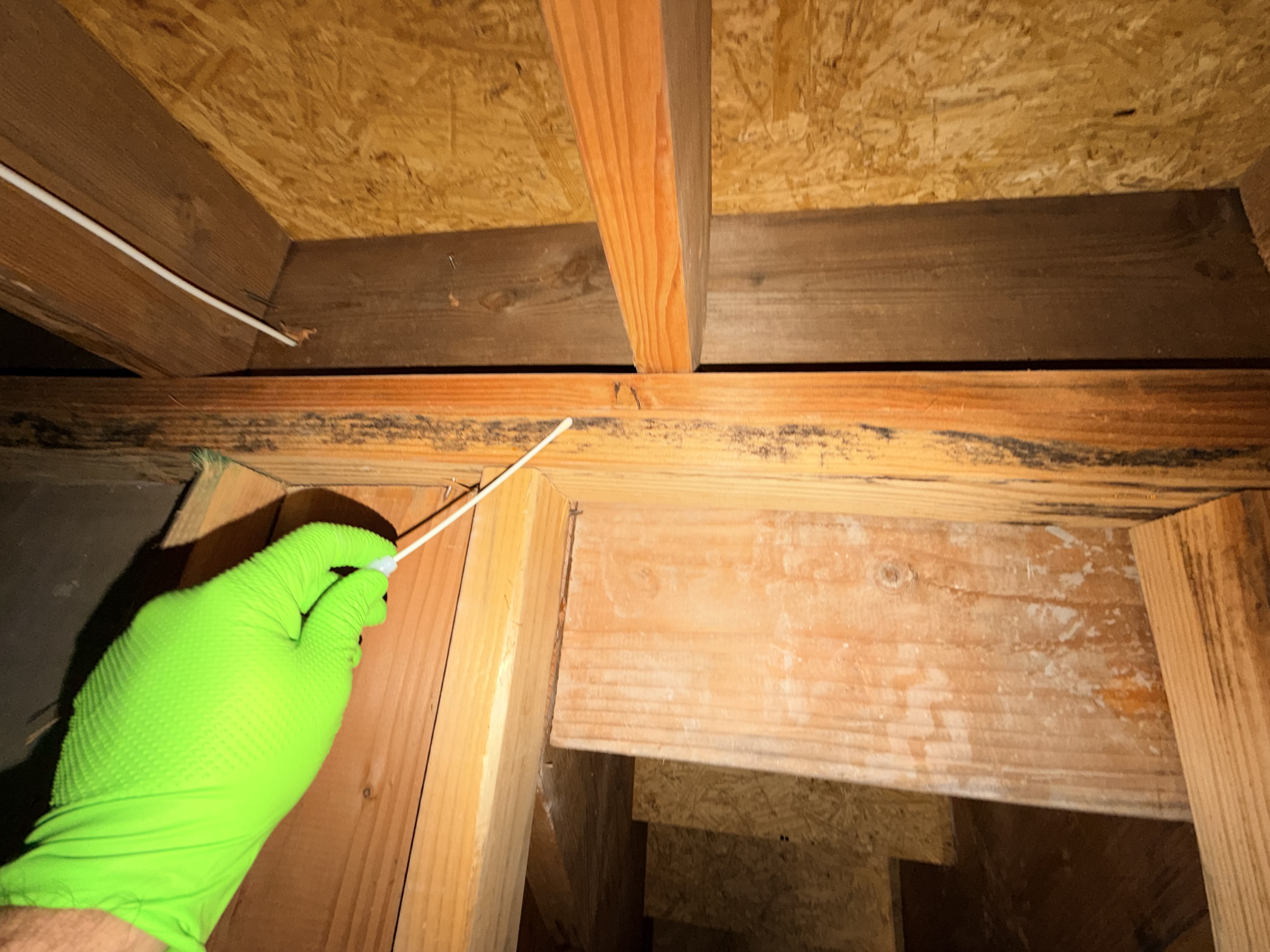
We inspect and test only. We never perform mold removal and we take no fee from any remediation, which is exactly why we are useful on this subject.
A large share of the white growth we are called to look at turns out to be efflorescence. A company selling the cleanup has no reason to tell you that. We do, and it costs us nothing to say it.
Where it is mold, laboratory analysis names the species, and moisture mapping finds the water. That gives you a mold problem defined by measurement rather than by how alarming it looked.
Common questions
How harmful is white mold?
For most healthy people, mildly. Risk rises with extent, duration and individual sensitivity, and it is materially higher for anyone immunocompromised.
Is white mold the same as black mold?
No. They are different organisms, and neither color predicts risk on its own.
Can I live in a house with white mold?
Usually yes, while the moisture is found and corrected. That is a decision for you and a physician if anyone in the house is symptomatic.
Should I test it?
Test when the affected area is large, when it keeps returning, when someone is immunocompromised, or when the finding has to be documented for a claim, a sale or a dispute.
Get an answer rather than a guess
We provide independent mold inspection and laboratory testing across Orange County, Los Angeles and Pasadena. If you have found something white and want to know whether it is a fungus or a salt deposit before spending money, that is a measurable question.
Get an objective answer for your property
Book a certified, independent inspection and get an objective, lab-backed report you can act on. Learn about a mold inspection.
- Independent, no remediation upsell
- Accredited-lab reporting
- ACAC & IICRC certified