

Mold inspection cost is the first question almost everyone asks, and it varies depending on several factors. Below is what the work costs in Southern California, what changes the final cost, and how to tell whether you are spending money on evidence or on a sales visit.
Related from GPMI: A mold inspection, independent and lab-based.
Quick answer: inspection prices at a glance
| Service Type | Typical Cost Range | What’s Included |
|---|---|---|
| Basic Mold Inspection | $150 to $500 | Visual inspection, moisture readings, thermal imaging, basic report |
| Mold Testing (with lab analysis) | $250 to $700 | Air or surface samples, laboratory analysis, species identification |
| Comprehensive Evaluation | $400 to $1,200 | Full inspection, multiple samples, moisture mapping, detailed report |
| Commercial / Large Properties | $1,000+ | Extensive testing, HVAC assessment, multiple zones, full documentation |
The national average for a standard inspection sits between $300 and $1,000. Where you land inside that depends on the factors below.
What changes the final cost
Property size and square footage
The single biggest driver. A home under 4,000 square feet commonly runs $300 to $400. Larger properties reach $700 to $1,000 because a whole house takes longer and needs more sampling. Commercial work starts around $1,000.
How many samples you actually need
Each sample carries lab fees. 1 location with visible growth may need a single swab. Multiple rooms, or mold in your home appearing in multiple areas, means additional samples and additional tests.
Air samples versus surface samples
Air samples measure airborne mold spores against an outdoor baseline and cost more because 2 are taken. Swab samples confirm what a visible patch is. Most inspections use one or the other, not both.
Accessibility
Crawl spaces, attics and anything behind drywall take longer. Special equipment such as a borescope adds time rather than a separate line item.
The mold species suspected
If a hazardous species is suspected, handling requirements rise and costs can reach $600 to $800 or more.
HVAC involvement
Testing an HVAC system where contamination is suspected typically adds $50 to $75.
Testing methods and what each costs
- Air cell testing. The common method for assessing airborne spores, part of our air quality testing. $250 to $700.
- Swab testing. For visible growth on a surface. $200 to $300 per sample.
- Culture testing. Grows living spores to confirm active mold colonies. Adds $50 to $75.
- Stain testing. Identifies mold species on a surface. Adds $150 to $200 in lab analysis.
What a professional evaluation includes
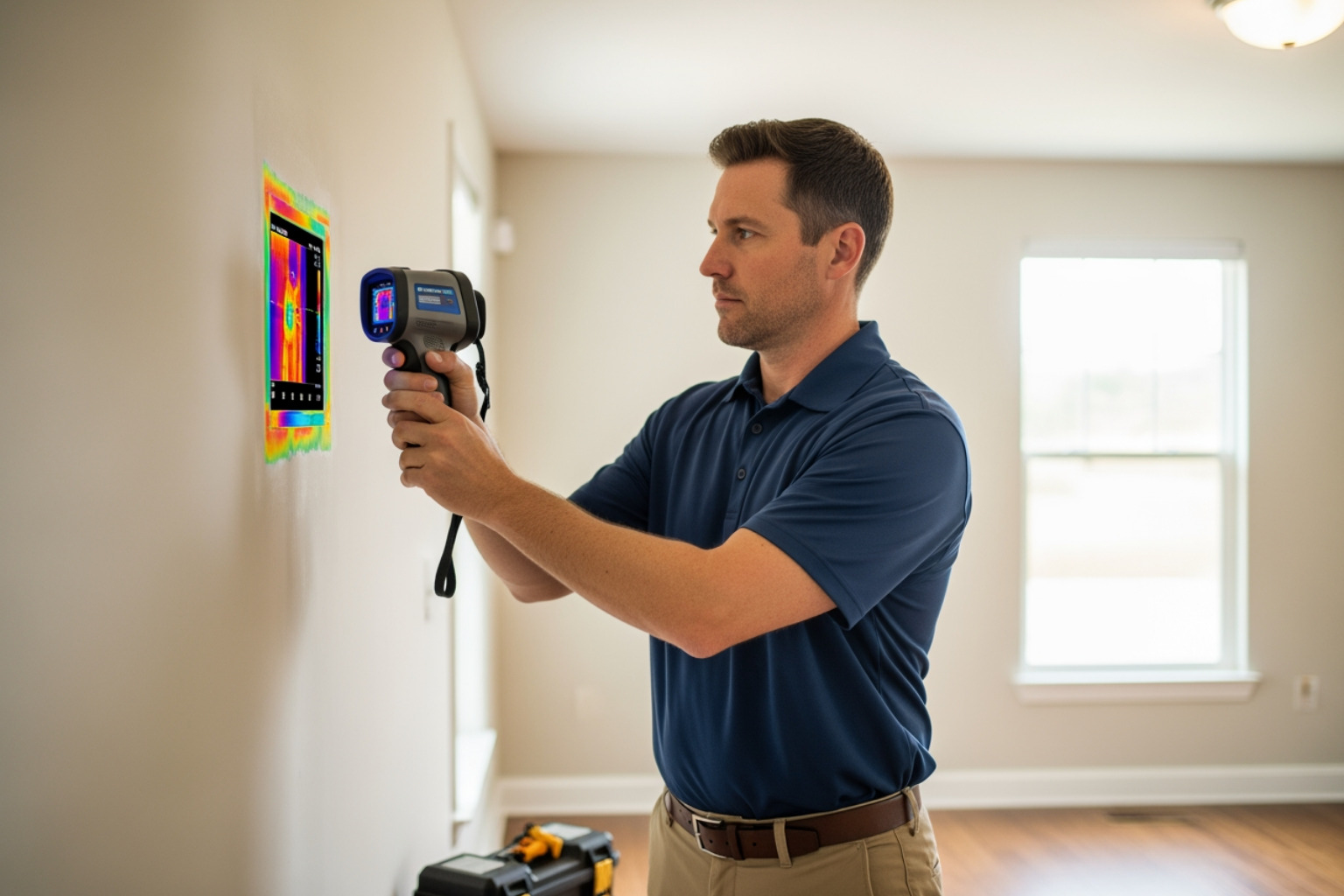
- Visual inspection. A methodical visual assessment of accessible areas, looking for growth, water stains and moisture sources.
- Infrared thermal imaging. Cameras that reveal temperature differences pointing to hidden mold and moisture behind finishes.
- Moisture meter readings. Precise readings in building materials, confirming whatever thermal imaging suggested.
- Air and surface sampling. Collected to a documented method so the lab result means something.
- Lab analysis. Sent to an independent accredited laboratory.
- A detailed report. Findings, lab results, the cause, and clear recommendations.
For the full method, see our mold investigation process.
Why a home inspector is not the same thing
A general home inspector notes visible discoloration in passing. They are not carrying a moisture meter into a crawl space or sending swab samples to a laboratory. If mold is the question, the answer needs an inspection built around it.
Do DIY kits save money?
They rarely do. Retail kits produce false positives readily, cannot tell you concentration against an outdoor baseline, and cannot find mold that is inside a wall. A kit that says “mold present” tells you what was already true of every building on earth.
The conflict of interest nobody warns you about

Here is the part that matters more than any number on this page.
Many inspectors also sell the cleanup. When the same company decides how much mold there is and then quotes to remove it, the incentive runs one way. Remediation companies quoting off their own inspection is how a small problem becomes a large invoice.
We inspect and test only. We never perform mold remediation, we take no fee from any remediation services, and we do not accept referral commissions. When we say the affected area is small, nothing about that costs us anything.
Ask any inspector you call 1 question: do you also do the removal? The answer tells you how to read their report.
Evaluation cost versus mold remediation costs
These are 2 separate budgets and they get confused constantly.
Inspection and testing is what you are reading about here. Mold remediation costs are what a licensed remediation company charges to do the work, commonly $1,150 to $3,400 and beyond $6,000 where mold spreads through structure or where structural damage is involved.
A proper evaluation is what makes that second number accurate rather than a guess. Contractors bidding without scope inflate to protect themselves.
When testing is worth it
- Confirming hidden mold. Musty odors with nothing visible.
- Guiding the remediation strategy. Knowing the mold type dictates containment.
- Post-remediation clearance. After the work, clearance testing confirms it succeeded. It has to be done by someone other than the company that did the work.
- Real estate and disputes. Where the finding has to be relied on by somebody else.
How to save money without cutting corners
- Act quickly. Mold can colonize within 24 to 48 hours of moisture exposure. Early detection is the largest saving available.
- Fix the moisture. Leaks, ventilation and keeping high humidity down between 30 and 50 percent prevent the next problem.
- Do not bundle inspection with removal. Separating them is what keeps the assessment unbiased.
- Check insurance. Some policies cover remediation following a covered event such as a burst pipe.
- Skip the air purifiers as a fix. They filter air passing through them and do nothing about wet material.
Can you get results the same day?
The inspection findings, yes. Laboratory results depend on the service level: standard results run 3 to 5 business days, post-remediation clearance and real estate transaction samples return within 48 hours, and 24-hour expedited results are available on request for an additional fee.
Common questions
How much does mold inspection cost in Southern California?
Most residential work falls between $300 and $700. How much mold is present and how many samples are needed decide where in that range you land.
How much does mold testing cost on its own?
$250 to $700 including lab analysis, depending on sample count.
Why do many inspectors quote so differently?
Because some quote an inspection and others quote an inspection plus the removal they intend to sell. Compare what is included, not the headline figure.
Are there additional costs after the report?
Not from us. You get a clear, itemized price up front.
Who pays for the inspection?
It depends on whether you are a tenant, a buyer, an owner or making an insurance claim.
What you are actually buying
A number on a report is not the product. The product is knowing what is there, how far it goes, why it is there, and what the evidence supports doing next, written by someone with nothing riding on the answer.
We provide independent mold inspection and laboratory testing across Orange County, Los Angeles County and Southern California. We do not diagnose or treat medical conditions. Our role is to provide objective environmental data, and where it helps, to refer you to physicians experienced in mold-related illness.
More on what an inspection costs and who pays
- Who pays for the inspection, landlord, tenant, buyer, seller and insurer, and how it actually lands
- How to choose a mold inspector, the 7 questions to ask on the phone, and 8 red flags
- Why independence changes the price, a free inspection is a sales call, and what that costs you later
- Cheap mold tests, why retail kits rarely save money
Get an objective answer for your property
Want a real number for your property? We give you a clear, itemized price up front, with no remediation upsell. Learn about a mold inspection.
- Independent, no remediation upsell
- Accredited-lab reporting
- ACAC & IICRC certified